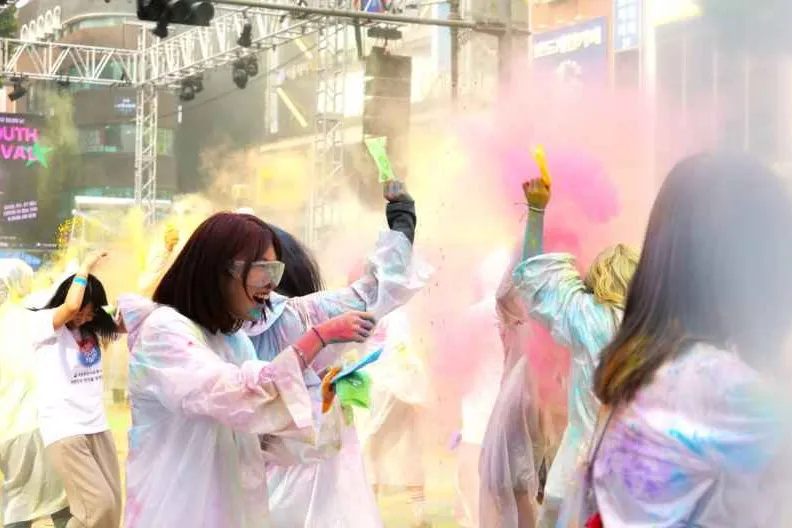
Korea Youth Day Festival
🗓️ 2026.09.18 ~ 2026.09.20
Korea Youth Day is a statutory anniversary that originated from a youth commemorative event proposed and led by the non-profit organization Youth and Future. Since 2016, Youth and Future has held Youth Day commemorative events every September to spread social consensus for designating Youth Day as a statutory anniversary and to increase national interest in the promotion of youth rights and interests. From 2017, it has used the official name <Korea Youth Day Festival> and developed it into a representative youth festival of Korea. Subsequently, on January 9, 2020, the ‘Framework Act on Young People,’ which contains the designation of Youth Day as a statutory anniversary, passed the plenary session of the National Assembly, and Youth Day was designated as a statutory anniversary on the third Saturday of September every year.
The Korea Youth Day Festival operates programs encompassing various fields for youth, including the promotion of youth policies, culture and arts, employment and entrepreneurship, performances, experiences, and the content industry. What distinguishes this festival from other large-scale youth events in Korea—such as university festivals or K-POP-focused concerts—is its explicit policy mandate: the integration of youth rights advocacy with mainstream entertainment. Attendees encounter both the Korea Youth Dream Gala Concerts and the Youth Policy Competition within the same program structure, a combination that reflects the festival’s dual purpose of celebration and civic engagement.
2026 Edition: 10th Anniversary in Busan
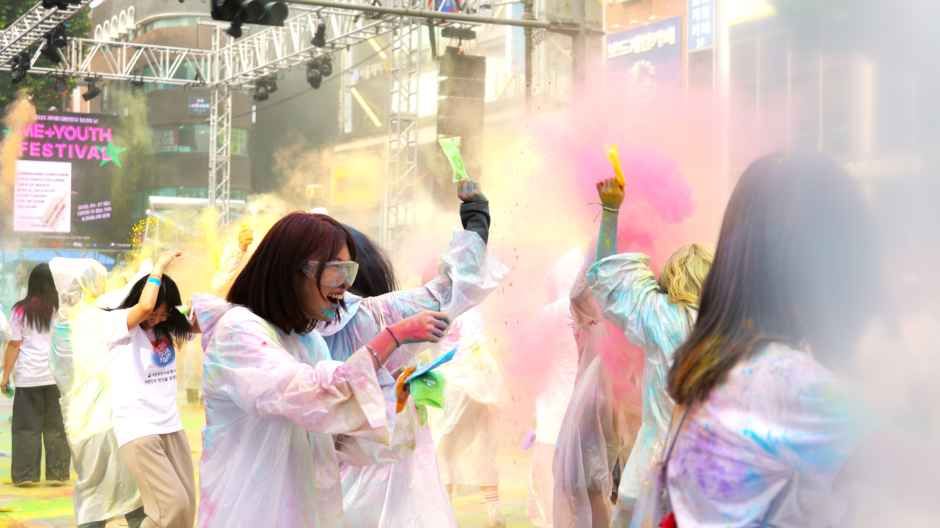
This year, marking the 10th anniversary of Youth Day, the 10th Korea Youth Day Festival relocates to the Gwangalli area of Busan Metropolitan City. The change of venue from previous editions (typically held in Seoul) represents the first time the festival has moved to a regional city, leveraging Busan’s coastal infrastructure and established event-hosting capacity. Gwangalli Beach, with its 1.4km shoreline and direct view of Gwangan Bridge, provides a built-in backdrop for evening programming and drone displays.
Program Structure
| Category | Programs |
|---|---|
| Main Programs | Drone Show, K-POP Concert, Creator Festival, Cheerleading Championship, Dance Challenge, University Song Festival, Youth 100-Person Chorus, Musical Gala Show, Silence DJing Dance |
| Side Programs | Opening Ceremony, Youth Startup Awards, Youth-Friendly Dedication Grand Prize, Youth Policy Competition |
| Consumer Participation Programs | Creator Fan Meet-up, Beauty Experience, MBTI Test, Youth Entrepreneurship Experience Booth, Dance Challenge, Company Experience Booths |
| Other Details | Food Festival |
Several programs warrant specific attention. The Youth 100-Person Chorus assembles participants through open application rather than institutional nomination, and the Silence DJing Dance—performed with wireless headphones distributed to audience members—addresses noise restrictions in the residential-adjacent venue. The Creator Festival and associated Creator Awards reflect the festival’s adaptation to content-industry employment trends, with 2024-2025 data showing creator-related career interest among South Korean youth exceeding traditional entertainment industry aspirations by a measurable margin.
Practical Information
| 📍 Address | 219 Gwanganhaebyeon-ro, Suyeong-gu, Busan (Gwangan-dong) |
| 💰 Fee | Free |
| 📞 Inquiry | 02-780-3939 |
| https://www.instagram.com/youth.future_official/ |
🛏️ Accommodation near the event
For Prospective Attendees
The festival’s free admission removes financial barriers, though capacity limits apply to seated indoor programs (the Musical Gala Show and specific Creator Fan Meet-ups). The September 18-20 timing coincides with post-monsoon stable weather in Busan, with historical data showing average temperatures of 21-26°C and precipitation probability below 15% for the period. Visitors combining the festival with coastal tourism should note that Gwangalli Beach swimming season officially concludes August 31, though the beachfront remains accessible and food-truck operations extend into October.
What is Busan’s significance in K-pop culture?
Busan occupies a specific place in K-pop’s development, less as a rival center to Seoul than as a laboratory where certain performance values took shape. The city produced artists who became central to the genre, and in doing so, established training and evaluation methods that larger companies later adopted.
The city’s working-class coastal identity is sometimes overstated, but it did produce a performance culture with particular characteristics. The late 1990s and early 2000s saw an active underground dance battle scene, competitive enough that participants developed genuine technical proficiency in freestyle and crowd engagement. These were practical skills—useful for clubs, for street performance, for any venue where set choreography wasn’t guaranteed. When major entertainment companies recruited from this pool, they found performers who could manage unexpected variables, who didn’t require carefully controlled environments.
Entertainment companies also used Busan as a testing market. The city’s geographic and demographic distance from Seoul made it useful for gauging how material might play more broadly. Audiences here developed reputations for being direct in their responses—unsparing when performances failed, enthusiastic when they succeeded. This created genuine pressure on performers, who learned to read rooms quickly and adjust. Whether this produced better artists or simply different ones remains debatable, but it did produce artists who could function under scrutiny.
The Busan One Asia Festival, launched in 2016, established some of the infrastructure and government relationships that support current K-pop tourism initiatives. The city’s port facilitated earlier exchange with Japanese and Southeast Asian markets, though this role is easy to exaggerate—Seoul remained the primary distribution center, with Busan functioning more as peripheral access point.
Contemporary significance is more measured. Multiple BTS and SEVENTEEN members originated here, along with artists from second-generation groups. Several training academies maintain and teach methodologies developed during earlier periods, though how faithfully they preserve these methods, and how relevant those methods remain to current industry demands, varies considerably. Busan’s role now is less transformative than sustaining—continuing to produce capable performers without claiming the cultural authority it once tested.
